All posts by The Scribe Staff

Q&A: Kyle Rauschelbach

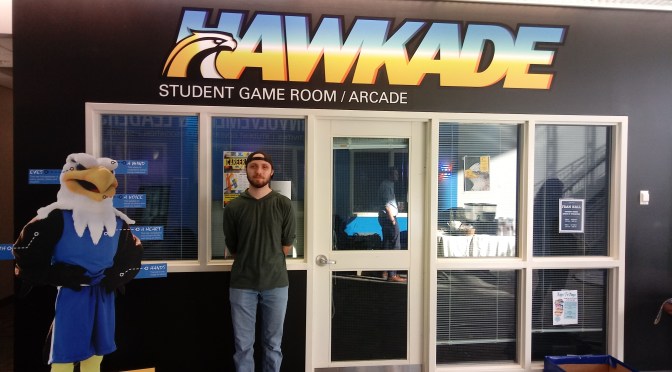
This past summer Franciscan Hall saw some renovations, including the addition of the “Hawkade” e-gaming center. The Hawkade is a not so large room that contains one Xbox One, one Playstation 4, an Xbox 360, and one original Xbox. For just being built, the room seems like a very fun place to hang out and play some games. But perhaps this is just the first step for Hilbert to try and begin an esports scene.

Kyle Rauschelbach, a senior student in the Cybersecurity program at Hilbert,works in the IT department at Hilbert and helped to build the new Hawkade.  Rauschelbach is also a part of the CyberHawks, a club at Hilbert that competes in network defense competitions. The Scribe sat down with Rauschelbach to talk about the new space.

The Scribe: . Do you play video games?

Kyle Rauschelbach: Yes, I’ve played video games since about middle school, if not before that.

TS: Are you interested in esports?

KR: Yeah of course. Esports are something I have watched for a while now. I was very into a game called Smite and I enjoyed watching the pros play that.

TS: Do you believe that the addition of a gaming lounge may point to a future of esports at Hilbert?

KR: Yes, I’ve always thought about that. They have that Hearthstone tournament that is a collegiate tournament. I totally want to get into a collegiate tournament. They have tournaments that are specifically for colleges in a lot of games and I think that would be a cool way to grow Hilbert. If we had an esports team that did well in any game I’m sure it would attract people to come to Hilbert.

The new Hawkade center is a very chill space to hangout and perhaps one day it will be a spot where people can compete for Hilbert in national competitions.

Q&A: Courtney Witherspoon

Courtney Witherspoon has a tough job. As the director of HEOP (Educationally and Economically disadvantaged Students) she has to do everything she can to keep Hilbert students from becoming a statistical College Dropout, a task that is particularly challenging as on-time college completion rates have decrease. The Scribe caught up with her to talk about the major obstacles to getting students through to graduation.

The Scribe: Data shows that graduation rates are lower among low-income students. What particular challenges do they face?

Courtney Witherspoon: I think at this point in time there is a change in the demographic of students that are going to college. If we go back to previous years, college students were mostly of Caucasian origins and middle upper class and that has changed in recent years, colleges are being asked to be accountable for accommodating more students. College in and of itself wasn’t made for minority students historically, so that’s a lot of history to overcome. It is about access to education, how much money it costs, and the support that the student is going to get when they get to college that determines whether that student is going to be able to stay and persist threw to graduate.

TS: What underlining factor or factors are causing low-income minorities to drop out before they get their bachelor’s degrees?

CW: So again I think it is about access to resources and a lot of the time its finances. College is expensive and because we have issues around resources including money often that is a barrier that students cannot overcome. College is expensive and it is only getting more expensive. I mean there are lots of initiative to help students. I am the director of HEOP for (educationally and economically disadvantaged students). It helps but we can’t fund everyone. There is “SAY YES Education” which is for Buffalo Public School graduates and doesn’t fund everyone either. A lot of the time the thing that I hear the most is that the underlining factor, money is the Issue.

TS: According to the National Student Clearing House, about a one third of the students who enroll in college still haven’t earned their bachelor’s degree at the six-year mark. Is that true of Hilbert’s black and Hispanic students?

CW: I think that the Population at Hilbert is a little different. I will give you a contrast. I worked at UB in my previous Job which had a completely different population in terms of it being a selective school. So already you are drawing from students that have had a lot more preparation and were probably more affluent in a lot more respects because they had access to more resources, so they were prepared to do better in school due to that advantage in order to get into UB which is a selective university. Because of that it is sometimes easier to make a distinction between your black and Latino students which are the underserved students as opposed, to an affluent white student. That is why it’s a little easier to tell at a place like UB, I think. Here at Hilbert we have students that live in rural area that don’t have a lot of resources.

Q&A: President Michael Brophy

by Brandon Job

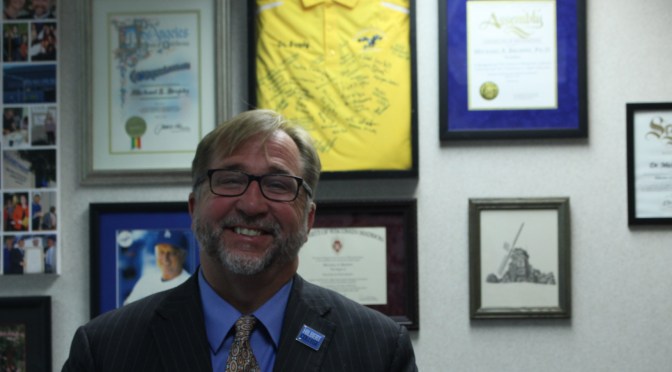
Last Year President Michael Brophy Moved from Los Angeles, CA back home to Western New York to take on a new assignment as the President of Hilbert College. He has been involved in higher education for 35 years, serving as president of Benedictine University and Marymount California University before arriving at Hilbert. He has earned multiple degrees, including a Ph.D in educational leadership and policy analysis from the University of Wisconsin – Madison. The Scribe had a chance to sit down President Brophy to talk about his transition to his new role.

The Scribe: Where are you from and what schools did you go to?

Michael Brophy: My wife and I are both from Western New York. I went to a college very similar to Hilbert called the College of Saint Rose in Albany, New York. I have been in college admissions for 35 years. Half of that was in admissions, so I spent a lot of time in the northeast recruiting students out of high school. And since 2002 I’ve been the CEO of four different institutions.

TS: What specifically drew you to Hilbert College?

MB: Two things: I was ready for my final assignment and I wanted to stay in the Catholic higher education system. And I was really impressed with the board of this institution. And the other thing is I was really looking forward to getting back to Western New York. We’ve been away for 17 years and this was a great opportunity to come back home.

TS: Is there anything you have seen that you would like to change since you’ve been here?

MB: Well, there are really four things. One is our athletics, and we’re going to do that by hiring more full time coaches, by building new fields and by trying to build a new track and field complex and hopefully these things will make a difference. Second is trying to go online with some programs such as law and justice to grow the college and make it more accessible. And we don’t want to be the best kept secret in the south towns. We have to become more aware for people in the area in order to help this college grow a bit. We are also going to try to attract more international students by hiring an international student council.

TS: Is there anything you want the students to know about yourself?

MB: We’ve made a lot of changes to the campus and it’s really all about the students. We moved administrative offices for student life experience and we will keep improving what we do for the students and to keep the good advice and good questions coming

Q&A: Kristina Lantzky

by Rosalie Constable

Dr. Kristina Lantzky holds an important position at Hilbert College. Her role as Provost and Vice President of Academic Affairs has given her the opportunity to make a positive and meaningful impact on the staff and students. To prove her love for the job, the Idaho native and proud mother of three drives to work from her home in Rochester everyday. Many students will go through their entire journey at Hilbert College and barely speak to Dr. Lantzy. The Scribe sat down with her to get to know the woman who cares so deeply about what is best for the students and staff of Hilbert College.

The Scribe: What does the Provost and President of Academic Affairs do?

 Dr. Lantzky: My job is to participate in two ways in the institution. So I participate in what’s called a shared government model. That involves faculty senate, staff senate, and senior staff. My role is to work closely with all of those entities and to make sure everybody has a voice and that we are transparent and engaged in looking at the institution holistically from what the needs of the faculty, staff, students, and administrators are. Then the other part of my job where I oversee. So I oversee student retention, the faculty, and the library. I also oversee what’s called the office of institutional research. So that is our data branch of the institution. All of our data is collected there. I also oversee the registrar’s office and online learning. I have a whole host of people who care about the students and work closely with students who we put together to make sure that the academic experience and somewhat the non-academic experience is very positive for our students.

TS: Did you always know that this was the type of work you wanted to do?

 DL:  Well I started at a small liberal arts school much like Hilbert and I was going to be a physician’s assistant or a physical therapist. I started as a biology major. I quickly got into general biology and said ew. Then I became a chemistry major and I got a chance to, when I was an undergraduate, be a tutor for chemistry. I got to work closely with my faculty doing undergraduate research. I loved college and I wanted to be part of the college experience. I loved when I got to substitute teach and all of this great stuff. So my faculty members that I was very close to pushed me to go to grad school. I knew that all I ever wanted to do in this world was teach and I thought that was what I was going to be doing for the rest of my life. I thought I would find a great school and teach and I did for thirteen years. Slowly I moved up the administrative ladder,slowly getting more responsibility. Then I wanted a change and a friend recommended to go and look at Hilbert. They had this provost position, an interim position, and I never thought I’d want to do it but I thought for a year it wouldn’t be bad. It turned out I really loved it. I love working with the faculty, the students, and the staff. So I didn’t always know that I wanted to do this but now that I’m doing it, I can’t imagine having another job.

TS: What would you say is the hardest part of your job?

 DL: I think the hardest part of my job is balancing everyone’s needs. The faculty and staff, both collectively and individually, may have different needs. Sometimes we have to make the hard decisions at the administrative level and it doesn’t make everyone happy. But the number one question we ask ourselves, is it good for our students? And then following it up, is it good for the faculty as a whole? Sometimes those are hard decisions to make but I know that in the end I get to make those decisions and I listen to what everybody tells me. Then we weigh it and we make the best decision we can at that time. It’s hard to know that the decisions we make don’t make everyone happy but the decisions we make, make a stronger and more robust institution.

TS: What would you say is the most rewarding part of your job?

 DL: The students. It is all about them. You know, I’m no longer in the classroom but I have three kids of my own and I can only hope someday when my kids go to college that they’re surrounded by faculty, staff, and administrators who not only care about student’s achievements, but also about their wellbeing. When a first-year student steps onto our campus and when they leave us after four years, the difference in them is amazing. I always tell parents, you will drop your students off and then they will come home for Christmas and you’ll look at them and go, “who is this kid?!” They are so much more mature and grown. Then when you look at them as seniors you think how they are going to go out into the world and be amazing and I got to be a small part of that. Just to watch our students go out into the world and be successful is everything that I need.

Q&A: Kim Buck

by Zach Jezioro

Kim Buck has seen a lot in her three decades as a court stenographer. The Scribe sat down with Buck to talk about what it takes to become a stenographer and some of the craziest things she’s seen in a court room.

TS: How did you get into being a court stenographer?

KB:  I saw it on TV when I was younger and thought it would be a really cool thing to do, that’s what got me interested getting into the position.

TS: What’s the most interesting case you have ever been a part of?

KB: Muzzammil Hassan, who murdered his wife by beheading her. It was noteworthy because it was in the news and people heard about it. I got to learn what his life was about and there were previous incidents that led up to it, it was a high profile case in the area.

TS:  How long have you been a court stenographer?

KB: Since 1990. I was with freelance for 11 years doing deposition work with the state for 18 years, mostly in the criminal part. I am currently training to transition into a supervisor position.

TS: How much time do you need to prepare for an upcoming case?

KB: Hard to say because I never know what’s going to happen.

TS: How long are you usually at a case?

KB: Depends on what is going on. I usually start at 9:30 am, a normal trial is 7 hours. Other days two or three hours, depending on what kind of proceeding it is.

TS: What are some challenges of being a court stenographer?

KB: Keeping control of the courtroom. People get nervous being there, so they start talking fast. Also, it’s not fun reading back in front of a jury.

TS: What is your favorite thing about being a court stenographer?

KB: I never know what’s going to happen. Everyday is a different case and it makes in interesting because you just never know what kind of case you’re going to get.

Hilbert Hosts County Executive Candidate Forum

Staff Reports

Hilbert College played host to a candidates forum featuring Erie County Executive Mark Poloncarz and his challenger in this fall’s election Erie County Legislator Lynne Dixon Wednesday night.

The well-attended event, which took place in Swan Auditorium and was organized by the Southtowns Regional Chamber of Commerce, saw the candidates discuss taxes, economic development and the future home of the Buffalo Bills.

Check out WBFO reporter Mike Desmond’s coverage of the forum.

Hawk Radio Prepares for College Radio Day

by Scott Peet

Hawk Radio is celebrating College Radio Day this year with a housewarming party in their new studio location.

Members of the station are inviting students to join in the celebration, which begins this Thursday, October 3rd at 3 p.m. The station will broadcast for twenty-four hours staright.  The station staff will be there to show off the new studio space in the Student Activities Center of Franciscan Hall, and hopes to pack the house with games, events, live performances and prizes through the night.

Program Director Rosalie Constable has taken the lead of organizing this year’s event and shared some of her plans with The Scribe, including a late night video game tournament.

“There’s the new Hawkade,” Constable said. “This will be the first time that we really get to utilize it so I’m excited to see how that works”. The games in this tournament are friendly and open to all, so it might be time to start practicing your skills at Mario Kart, Pac-Man and Centipede.

Ryan Zunner, Hawk Radio’s station manager, will be taking to the stage with his new band “The Midnight Ramblers” for their very first performance.  Their blend of modern music and classic and blues rock will be there to add some energy to the evening at 8 p.m.  Following this live act, there will be an open mic hour where students and staff can show off their talents, musical or otherwise.

The nine-year-old station has seen some ebbs and flows in participation in the past, but this move seems to be sparking interest and awareness of their presence on campus. “Getting more of a visible place where people can see and interact with us I think will be important,” Zunner said.

Hawk Radio is still in its infancy as far as college radio stations are concerned, but this can be a springboard for them to boost their outreach throughout the college and bring in new listeners or team members.

This event is free to attend and all are welcome to use and enjoy the space throughout the evening. There will be a few chances to win prizes including a raffle for a front row parking space. The winner of this spot will have VIP parking privileges for one week outside of Paczesny Hall. Team members will also be selling popcorn during the movies where they will continue with their radio theme featuring “Talk Radio” and “Good Morning Vietnam”.

In previous years, funds raised during College Radio Day were donated to outside organizations,. This year all proceeds will be directly focused on improving Hawk Radio. The station does not receive funding through the Student Government Association and is instead supported through donations and out of pocket expenses paid by Faculty Advisor Don Vincent and staff.

“Raising money for ourselves is really important right now, so we can make the station better for the people involved in the station, and the college as a whole,” Constable said

This housewarming party is part of the 9th annual World College Radio Day meant to promote awareness of this unique platform and the hundreds of stations around the globe that will participate. College radio is an outlet for students to share their creativity with an audience and the medium has a long tradition in providing a place for free thinking and independent content. The new location combined with the event is being viewed as an opportunity for growth and expansion by Zunner.

“To actually have our own dedicated studio room and to really showcase that to the campus is going to be a really fun time,” he said.

For those who cannot attend in person, the broadcast will be available through hawkradio.hilbert.edu.

Q&A: Logan Yotter

By Adam Connelly

Senior Logan Yotter has seen first hand how service learning can enhance a student’s collegiate experience. He is involved with Kaely’s Kindness, an organization in Buffalo that helps out with teen girls’ that have cancer. Logan, who will be graduating in Spring 2020, with a Bachelor’s Degree in Criminal Justice and is involved with various events on campus, including Student Athletics Advisors Committee and men’s cross country, continues to stay involved with the organization. He is planning on being a The Scribe sat down with him to talk about Kaely’s Kindness and service learning.

The Scribe: How did you get involved with Kaely’s Kindness?

 Logan Yotter: About freshman year I was in a biology class and for one of the extra credit projects was to do service learning projects. If we did that we can get half of our credit through that. You know I wanted to try something new being a freshman here, so one of the options listed was to do something large like a 5k. I was like okay, you know I’m a runner so I decided to go through that and then that’s how I basically got it all started.

TS: What is the purpose of Kaely’s Kindness?

 LY: The main purpose why I started, like I said, was for the extra credit. But then I got more into this I found out like what the foundation was about helping teen girls with cancer.  I started working with people that created 5k’s and raising a lot of awareness and money for the foundation.

TS: How many years have you been helping out for?

 LY: Well it’s in my Senior year right now so three years total, but I actually am passing it off to the foundation this year. So I’ll keep working with them, but I also be helping out.

TS: How do you feel accomplished in helping outside the community?

 LY: You know it’s quite a big responsibility, and I really didn’t think much of it from the start. Looking back on it, you see the community impact all the way around raising almost $7,000 that can go a long way.

Kaely’s Kindness has not set a date for this year’s 5k race. Check their website for updates on the race and other fundraising events.

Q&A: Jessica Lively

by Dylan Timmell

Over the fall semester, Hilbert College opened a new café called 78 West, bringing much excitement to the students and faculty. Hilbert’s president, Dr. Michael Brophy, went throughout the campus asking faculty what they believe would be great revision ideas for the campus. Food service director, Jessica Lively came up with the idea to have students congregate around food and involvement which was approved. The project started over the summer and was completed shortly after classes started. It has been a big change for both the campus and Lively who now oversees the campus dining hall and the café.

The Scribe: How long did the project and construction take to complete the café?

Jessica Lively: I would say the project and construction was about a month long. They had to change stuff in that backroom and then build that wall on the outside where the door goes behind which was probably about a month.

TS: Do you know who was involved in the idea of the café?

JL: Honestly, I’ve been trying to get something else here for the students. So that Dr. Brophy came and asked everybody on campus, what this campus needed that was my top things that we needed somewhere else for students to be able to eat and drink.

TS: Do you know why they named it 78 West Café?

JL: So, originally it was supposed to be 43 North which is the latitude of Buffalo. But, there is a brewery somewhere that’s 43 North so they didn’t let us use that. The longitude then is 78 West. It is the same café name we use at Daemen.

TS: Who works at the café? Is it mostly kitchen staff?

JL: Yeah, so we hired two baristas to work there Adrian and Hillary. Adrian had worked with us previously a couple of years ago and we hired Hillary as a fresh new employee so I have to help out over there. So yes, it is our staff.

TS: Is it possible students will ever be able to work alongside the kitchen staff?

JL: Yup, We hire students (in the kitchen) so it will be the same thing there. If there are more people and more staff then yes, we would hire over there.

TS: Some students have been asking about Hawk bucks, how they can be purchased and if you can use a credit card?

JL: You can do hawk bucks a couple of ways. So if you go to the link through Hilbert’s website go to living on campus, then dining and then there’s a link to our website. You can purchase Hawk bucks there or you can do it at the dining hall with cash, credit card, a check, and if parents call us we can charge them over the phone. It’s pretty simple and then as soon as we get that, funds transacted, we can add them here on the computer.

TS: What are a few items on the café that they offer?

JL: Every kind of drink that you can get at Starbucks or Spot. Iced and hot, frozen drinks and then hopefully this week we will have a cooler case that is coming that will also display salads and wraps. We got some fun pudding and desert parfaits, yogurt and granola parfaits coming and then right now currently there’s muffins and cookies there. Every day were going to do some chocolate dipped pretzels and a couple other gluten free deserts we got that we have in mind that we want to try also.

TS: What seems to be the top three popular items on the list?

JL: I would say probably the frozen hawk mocha is the number one drink, I noted when I was over there earlier this week that vanilla latte is, and probably the big cookies. Everyone wants those big cookies over there.

TS: Do you think this would help with the student involvement and engagement?

JL: Yeah, we’re trying to work on a plan where students can use the café for their events for the Agape Latte; We’re trying to figure out how we can use that instead of setting up deserts and an iced coffee bar there. So we’re still working on that so hopefully that we can get that to be used for events.
Q&A: Don Vincent

by Scott Peet

Hawk Radio is seeing a lot of exciting changes this year. Entering its ninth school year under the guidance of Dr. Don Vincent there is a renewed energy amongst the staff. A new and improved studio has brought interest back to the station and a cast of fresh voices will be taking to the air.

The Scribe sat down to talk with Vincent about the changes and what he hopes to see happen this year.

The Scribe: What’s new for Hawk Radio this year?

 Doctor Vincent: We have a new feature that we are going to start. We’re going to call it faculty favorites.  We’re going to highlight a favorite song from a faculty member on Fridays where we will air the song four times at 9AM, noon, 3PM and 6PM. And we’re going to pre-record a segment with the faculty member where they explain the significance of the song. I thought it would be a fun way to get the faculty engaged in  (Hawk Radio) and maybe students would be interested in what songs faculty like. I will probably extend it to also staff and administration.

TS: What are the benefits of the new location?

 DV: Our new location is going to be in Franciscan Hall which is part of this new movement for the college to get more students engaged in that building. We’re going to be housed in the same area of student activities and also there’s the new video arcade. We feel like this new location will put us at the center of student action. I think that’s exciting. Though I like where we are now, we’re kind of closed off from the campus and it’s something that seems exclusive to communication students and we really don’t want it to be that. It’s something that belongs to the whole campus, so I think that this new location puts us at the center of campus in our coolest building.

TS: Who is invited to join?

 DV: Everybody. Absolutely everybody. We get a lot of interest from comm students, but anybody that has any interest in talking, or if you have a musical taste that you want to share with people, we would love to have you. There are really no restrictions on what people can do on the air, as long as it’s relatively appropriate. It’s an opportunity for students to express themselves and express their creativity, so anybody that wants to do their own show, they can certainly do that. Or if they just want to be involved in the marketing of the station, we definitely need people that are interested in helping us make the station more prevalent. We want to get people listening to it, so if people can come up with ideas for contests or events we can do that will get people engaged that would be great, or if people just want to do some behind the scenes production work too. Even beyond students, faculty and staff, they can all get involved.

TS: What does the station need to improve quality and outreach?

 DV: We really need more people.  More students involved. Right now we’ve got three or four students that are really actively involved and engaged, and I think we could use a handful more of those. As the faculty advisor, I would love to be able to step away from it a little bit more and make it more of a student run station than it currently is. I think we need more voices, more people and more ideas.

 TS: What type of content would you like to have on the air?

 DV: One thing I would really like to do is have some sort of news, maybe like a magazine show. It’s probably not practical to do like a daily news show, although I suppose that’s possible if we had journalism students or maybe even political science students that would be interested in doing a daily update that would be great. Maybe some sort of audio version of The Scribe, I think would be neat, so that the articles that students are writing for journalism classes, turning those into audio pieces. I would like to perhaps broadcast some live sporting events. It’s been a couple of years since we’ve done some men’s basketball games. I would like to do some men’s and women’s basketball, some of the outdoor events, soccer, baseball softball, stuff like that.

TS: Do you have a favorite Hawk Radio show from over the years?

 DV: One I liked a lot was a show that was done by a student named Garrett Derkovitz which was called Old But Gold. It highlighted music from the 1950’s and it seems like a genre that college students might not be interested in. I think he presented it in a really cool way and it was a tight show. He delivered the information about the song quickly, and immediately got back into the song. It was a really well produced show.

 For those who would like to listen in on all of the shows this year, an official schedule of hosts and times is soon to come. Stay tuned for more event information as they will be hosting several throughout the year including a twenty-four hour broadcast on College Radio Day beginning Thursday, October 3rd at 3 p.m. This event will serve as a house warming party for the new studio with entertainment, games and prizes throughout the night. Hawk Radio programming is available to be heard around the clock on your computer or phone, and they encourage you to visit the URL hawkradio.hilbert.edu. Just click on the link to open it in your browser and help support the station as it continues to grow.