Category Archives: Uncategorized

Hawks In the Hallway — Real Hawks

By Angella Rocklein

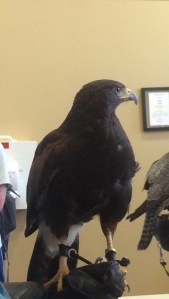
On Wednesday the 21st you may have spotted two beautiful hawks being displayed in Bogel Hall. The hawks were brought to campus by Matt Zymanek. He has been training and taking care of birds of prey for over 20 years at the Hawk Creek Wildlife Center in East Aurora.

Blaze, a male Harris hawk

The visit to campus was organized as part of Hilbert’s True Blue Week.
Chase is a male Harris hawk from St. Louis. The bird seemed calm, and was defined by red streaks in his wings and white tipped feathers on his tail.
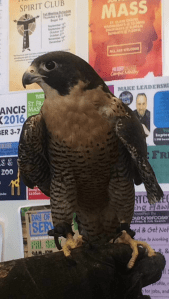
The other bird was Blaze,  a female Peregrine falcon.  Blaze has an injured wing, but a healthy Peregrine is one of the fastest animals in nature, with the ability to travel more than 200 mph while swooping in on prey.
Zymanek said the wildlife center is in need. Over the past few years winter has worn down the Wildlife Center.  The roofs are starting to cave in, and cages have also been destroyed. Everything has been repaired to the best of its ability. The “Snowvember” storm is mostly to blame for the damage, but cold temperatures also contribute. Donations can be made at www.hawkcreek.org.

Chase, a female Peregrine falcon


Hawk Creek has been seen on Rachel Ray, Steve Harvey, The Today Show, PBS, & Nat Geo. This center has award winning programs, they even have it so you can walk with eagles. You even have the opportunity to “Adopt” an animal. Hawk Creek has more than just birds, other animals include reptiles, wild cats and mammals (fox, horse, skunk, opossum, otter, and porcupine).

Fall Fest: Fun and Games

By Amber Coyle

This past weekend we capped off True Blue Week, where we celebrated a new year at Hilbert College.  True Blue Weekend was filled with events for students, staff, alumni, family and friends to join in and have fun. Throughout the weekend there were events such as a chicken barbeque, Fall Fest, murder mystery dinner, paint night and a few sporting events.

The Fall Fest had tables set up for anyone to get a personalized phone case or key chain.  Another table had road signs that you could personalize with whatever you wanted.  Music played in the main quad and people ran  through the boot camp blow up obstacle course. You could also get something to eat at the barbeque and get a cotton candy snack.

At the murder mystery dinner, actors came to all the tables and talked to everyone and introduced themselves before the show started.  Once the show started you had to listen for hints and clues about who was the real killer.  It was similar to a real life game of Clue.  The actors told amusing jokes and everyone seemed to be having a good time.  During the show we had a three course meal, which was delicious.

After the dinner was over there was paint night with Jake Peters, who offered tips to those new at painting. Throughout the lesson you could hear people saying how they thought they were doing a bad job or that they messed up, but Peters was encouraging.

According to Tommy Vane, Director of Student Activities, this was the 3rd annual True Blue Week.  Organizers included Institutional Advancement, Communications, Dean of Students, Student Activities, Residence Life, and Athletics. The purpose of True Blue Week is to celebrate Hilbert as a community, alumni and current students and staff.  Also we welcome friends and family of students and staff to come out and take part in the Hilbert community and show the Hilbert Hawks pride by wearing blue, white and black. True Blue Week lets Hilbert College to stop and come together as a community.


Transfer Students See Opportunity and Convenience Here

By Kylie Wooliver

Transfer students make up 30% of our incoming class this school year. This semester, roughly 80 students transferred from other colleges like ECC and NCCC. The graduating class includes 33% of transfer students. So, why did these students relocate to Hilbert College?

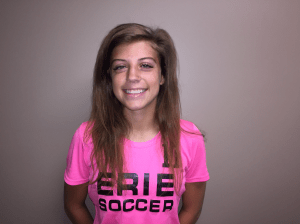
Nicole Plucinski
Nicole Plucinski

Nicole Plucinski, a Marilla native and a junior, attended ECC South before transferring to Hilbert this year. She studied Liberal Arts and Humanities, so the Digital Media and Communication major caught her eye. Plucinski said  she enjoys the small, personable campus community. She also said Hilbert was the best choice for her financially. The transfer was made easier given that Hilbert has a soccer team. Nicole is a member of the Women’s soccer team, as well as a member in the Honors program. Her previous soccer coach at ECC knew of Hilbert’s coach. Plucinski competes on the soccer team while still maintaining Honor status. She said that through sports, she has been able to bond with her team, which has made the process of starting at a new school easier.

Jenah Schwabel
Jenah Schwabel

Jenah Schwabel, also a transfer from Erie Community College, said that “stopping  my college experience where be foolish.” After finishing her two-year degree in General Studies at ECC, Schwabel decided to keep going with her education. “Sometimes you believe you are making the right decision at that particular moment in time, but when it’s said and done, something feels like its missing,” she said. “Some people believe ‘transfer’ means failure—that they were wrong in their first choice, while others believe that it’s a race to improve yourself.” Jenah said she heard a lot of good things about Hilbert, such as the small class size, and she liked how close it was to her home in Eden. Schwabel appreciates how Hilbert’s programs allow students a lot of hands on experience. Overall, she saw Hilbert as a new opportunity to achieve a degree in something she was passionate about.

Kathleen Wengrzycki, Hilbert Admissions, said that students transfer from many different colleges, and that their attitudes are positive. New students seem excited to begin their careers at their school! Kathleen adds that Admissions work well on an individual basis, which in turn, shows that they care.


OPINION: Player Protest is OK, but Don’t Kneel for Anthem

By Stephen Szynmura


In recent weeks there has been some NFL players who had started to kneel for the National Anthem. It all started with the quarterback from San Francisco named Colin Keapernick. After Kaepernick took a knee during the National Anthem there was a reaction from both sides. Fans were burning his jerseys others were buying his jerseys in support of him. To my surprise, other NFL players and even athletes in other sports have joined the protest.

Now you may ask yourself why are some players kneeling during the National Anthem? Isn’t that disrespectful to the flag and the whole country? The answer is yes, it is disrespectful, but on the other hand people can do such things because the United States citizens have the freedom of speech.

How can football players speak for the people who are actually having troubles with the police? Football players make millions of dollars each year and couldn’t care less what the little guy has to say.

Taking a knee during the National Anthem is just something that should not be done. It is very disrespectful to many people that love this country. I love this country and I show it differently that Kaepernick does. I find it hard to believe that Kaepernick loves this great country when he kneels for the National Anthem. I do realize that there are people who are in the military that have backed Colin Kaepernick and kneeling, but I have yet to see Kaepernick do anything with his money like make a donation to a cause that speaks to the issues he’s protesting. It seems like he is doing this to create a distraction.

Some athletes are doing a type of protest which I can get behind. They are linking arms together to show that they are one. Some are also sticking their one arm in the air which is also acceptable in my eyes. If a team links arms or puts an arm up I am OK with it. It shows respect to the National Anthem and a person or team can still protest so it is like the best of both worlds right there.

People are free to do as they will. A person has the freedom to protest, but there are certain kinds of protests that just are not the right kinds for football players to perform while they are playing a game. There are better ways to protest so why do a protest that would cause an uproar that could possible get you cut from your team. Then again, you can’t control what a person dose because you would be controlling their freedom which is something that should never happen.       

Despite Last in Polls, Soccer Women Want to “Write the Future”

By Nicole Plucinski

The Hilbert Hawks Women’s Soccer Team says despite the fact they are ranked last in their conference this year, they are still looking to “write the future.”

The Allegheny Mountain Collegiate Conference released the 2016 Women’s Soccer Preseason poll on Aug. 4. In this poll, all of the coaches in the conference vote on how they feel teams will do in their upcoming season. When this poll comes out, every coach anxiously awaits to see their fate.

However, this year’s ranking really hits home for the Hilbert Hawks. “The fact that we were ranked 10th (last) in the preseason poll only says one thing and that it’s time, time for us to gain our respect in our conference,” said Head Coach Kelly Starchok.

Starchok believes that it is easy for the other coaches in the league to place Hilbert in tenth because Hilbert has not been in the playoffs since she took over in 2011.

“Our returners are a very solid, talented core, the best since I started. They are committed to change the perception to change the perception others seem to have of Hilbert. Our seniors want to go out on a high, and are tired of being ranked last too, so they are challenging the rest of the team to raise the level of play.”

Starchok said the team’s newcomers bring “Youth, experience, maturity, and grit.”

This season for the Hawks has a well-balanced non-conference schedule, that will prepare the Hawks for conference play beginning on Sept 24. The Hawks are looking to utilize the seven non-conference games to prepare the team to peak just in time as Conference begins, and to be discipline in their style of play with a solid defending block, strong attacking shape and set pieces.

Starchok picks a quote she likes to use for that playing season, and “Write the future” couldn’t be more fitting for the 2016 team. “With our opponents in the AMCC ranking us 10th, they’re trying to write the future for us, instead of the other teams writing our fate for us, we are going to take it into our own hands and write our own future and destiny as players and as a program as a whole.”

Dining Hall Changes Include Fewer Choices

By Angella Rocklein

Hilbert’s Food Services has made changes to the way things work in the dining hall this year. Food Services Director Jessica Lively acknowledged that there will be fewer choices available, but overall the purpose of the changes were to make the process smoother at meal times.
“Instead of students being able to specifically select what they want inside – for example tomatoes and lettuce in a Buffalo chicken wrap – everything on the menu is a complete meal,” Lively said. “Everything is all put together and has a side, instead of (the sides) being chosen like last semester.”
Lively said if a student wants to leave out an item, they still can ask that it be excluded from their meal.
“Having less options makes it easier for people who are indecisive,” Lively said.

Another change is related to variety. Beginning this semester, the lunch and dinner menus will now be the same. This won’t be permanent though, Lively said.
In the future, each meal time will have a different menu, and the breakfast menu will be revamped, but there’s no time frame for putting that in place right now.
According to Lively, prices of the meals will remain the same through the college meal plans.
Lively said that the changes were made in response to student complaints about wrong orders. With the new system, each meal will be prepared in a standard way, cutting down on mistakes. Lively said it will be much more like ordering in a restaurant.

Welcome to The Scribe

To the Hilbert College Community:

We are The Scribe — the college’s first student-run all-digital news source. We exist to provide students an opportunity to practice real journalism in real time. We are also a source of information and commentary on campus and issues affecting the campus community.

To be on the staff, you must enroll in Comm 343, Journalism Practicum, offered each semester. The practicum provides a newsroom-like environment in which we can practice our craft.

If you don’t want to take the class but still want to contribute, you can send articles or story ideas to me, the faculty adviser, at dhiggins@hilbert.edu.

I look forward to meeting you through these pages, our social media, and at in-person events.

Bannon speaks, and teaches, “Language of Photography”

by Libby Marinaccio

BUFFALO – It’s not every day that a well-respected and established photographer walks into a Hilbert classroom to talk about his journey and passion for photos. It’s even more exciting when that happens for not just one class or one day, but for an entire two weeks. That talented photographer, Brendan Bannon, found himself in Buffalo for a residency stay at Hilbert College during the month of April.
Brendan Bannon has an impressive portfolio to the eyes and ears. Bannon has traveled around the world to places like Syria and Africa, has had photos published by The New York Times, and immersed himself in the everyday experiences of others. But above all the anticipated prestige, it’s clear within seconds that Bannon is driven by curiosity and a love for photography.
Every picture he takes has a story, and he is quick to point out that it is never just one tale. There is the real story, the events that surrounded the moment being captured, and then there are the perceived stories. They are the narratives we conjure up in our minds around images without knowing anything beyond what our eyes can see. When anyone has the opportunity to see Bannon’s work, they are witnessing his remarkable ability to find beauty in the ugliness of life. Once a viewer looks past the light, contrast, form, and color, they are forced to absorb the realities of the millions of other people in the world without the comforts of America. Bannon explained that he was motivated to travel to third-world countries after 9/11 when President Bush encouraged Americans that the best thing they could do for their country was to “go shopping.”
However, Bannon was not trying to make us uncomfortable about the underappreciated fortunes of living in America. Instead he spoke of the limitations of photography. Pictures may be worth a thousand words, but everyone interprets images into different words, sentences, and stories. Bannon explained that his work only captures a split second of life; a photograph is unable to encapsulate the dual realities of his subjects. He digressed into a quick anecdote about a group of refugee women that roared with laughter at his expense for being unmarried and without children at over 40 years old.
Perspective is what Bannon’s work graces to others. There are multiple perspectives to be captured, and it is up to a photographer to not only seek the best vantage point to secure a beautifully composed visual, but to also think about what that image will relate to others.
His advice to starters was wise in its simplicity: Bannon stressed the importance of positioning and persistence. Photographers must first put themselves in a spot that maximizes the opportunities for action. He demonstrated the importance of this by scanning the DMAC lab and pragmatically stating that “Inside the circle is where I want to be.” Standing inside the circular hub of computers places him at the epicenter of actions, where watching three students means three times the opportunity of a great photo than hovering over a single student or subject.
Secondly, photographers must have endurance. They always need to be ready for shots because putting down the camera for even the slightest moment is giving up. He believes that your first priority is to find the light, but make sure that you’re positioning yourself in a place to catch a subject’s movement at any moment.
Lastly, he gave a few technical pointers. He would rather operate with a higher ISO than use a flash, even if that means dealing with more grain. Flash is tricky to master, and the times he has tried have usually been under pressure or rushed, resulting in poor photos. When asked by Daniel Higgins, the Journalism professor at Hilbert, about where he stands on the classic Cannon versus Nikon debate, Bannon simply replied, “I use a Cannon.” He believes they are easier to learn and use, but had nothing negative to say about Nikon.
As the stories winded down, Bannon encouraged a literal round of questions by the students gathered at the DMAC table. He was asked about his experiences with Syrian refugees and if ever in his quest to document their stories through photos, his subjects ever wondered about his own tale? “Of course,” he responded. They are usually quick to question his sanity for leaving America, a place they all yearn to live, to be in lesser-prosperous nations and countries with only the comfort of his camera. He was also asked what is was like to be around Kenyan athletes, to which he remarked “It was amazing to wake up to the sound of all those feet moving.”

Bannon answering questions from students about his time in Syria and Kenya.
Photo by Libby Marinaccio

Bannon spoke about his first job for the New York Times where he was asked to photograph the very first baby boomer. When he came back with a series of photos ranging from the man’s infancy, childhood, workplace and home, it was clear that photography was more to Bannon than an assignment. It was his dedication to the story and willingness to go farther than other freelance photographers that ultimately lead to a series of jobs from The New York Times, including the hunt for escaped convicts Richard Matt and David Sweat in June of last year. He garnered a small rumble of nervous laughter while reflecting on a sobering observation, “I looked around and realized that I was the only one without a bulletproof vest on.”
Bannon was passionate while explaining the role he plays in educating students about the importance of photography, “To say photographers show up and don’t have an impact is ridiculous.” He was emphatic about preserving the organic nature of newsworthy events. Photojournalists must capture images of reality, what is actually happening, while doing their best to not influence those events with the clicking of their cameras. Bannon said it is acceptable to anticipate gestures, movement, and potential shots, but never manipulate such elements, “I’m not directing photographs.”
Students of all backgrounds, interests, and majors have something take away from being in Brendan Bannon’s presence. His stories highlight an important truth about life: Anyone that is passionate about something needs to embrace all aspects of it in order to succeed. Photography, and photojournalism especially, are more than just a forms of art; picking up a camera means taking the responsibility of it’s power and influence.
Brendan Bannon’s portfolio is undoubtedly stunning. The hundreds of images that he’s taken over the years are souvenirs of his work, travel, and life that irrefutably prove photography is a language of it’s own.

Finals Week: Try Not to Worry


By Kyle English

Hilbert Students, final exams are just around the corner.  Friday, May 6 kicks off day one of the Spring Semester’s final exam week.

Many students begin to panic and freak out when it comes to studying for their exams.  In reality, they are no different than any other test you take in your academic career.  And worrying about them may make everything worse.

There are several ways to help you prepare and score well on all of your final exams so you can enjoy the summer, and not re-take any classes.

Here is the Huffington Post’s Top 12 Tips for Acing Your Finals:

  • Study in Chunks. “Chunking” is the process of studying in smaller sessions for 20-50 minutes at a time, taking 5-10 minute breaks in between each session. DO NOT CRAM.
  • Listen to Mozart. Mozart’s music and other classical compositions that follow a 60 bpm pattern (beats per minute) activates both the left and the right side of the brain, optimizing your brain’s activity and enhancing your recall.
  • Alternate Study Spots. Studying in different spots will help you concentrate while reviewing notes and material
  • Drink Cocoa. Cocoa (hot chocolate) is filled with antioxidants, cognitive and mood enhancers.  Keep this cocoa as pure as possible, because once sugar is added your energy rush will lead to a crash.
  • Form a Study Group. Studying in groups or even pairs will help you get motivated to start studying which is often the biggest challenge for many.  Also, this will allow you to “divide and conquer” terms and phrases which you can then teach to each other.
  • Prevent Test Anxiety. While studying, try to get your stressed out so you can re-enact “game time”.  Studying under stress will help you on the day of the test perform well under pressure.  Another option, is imagine yourself getting the test back and acing it, this will build confidence and naturally calm you down, before taking the exam,
  • Jog Around Campus. Just 20 minutes of cardio can improve your memory.  Jogging outside and viewing nature will enhance your memory even further, while engaging and appreciating nature even more.
  • Manage Your Time. Give yourself enough time to study and prepare for your finals.  Maybe take less hours at work, and avoid scheduling things so close together.
  • Go to Office Hours. Talk to your professors and utilize the time they set aside to help students.  That is what they are there for.  They will help you clarify material and offer suggestions that will help you remember or help you study.

10.) Approach Class Differently.  Each subject may require a different study approach.  Try switching up for studying technique for each class.

11.) Build on What You Know.  Start studying what you know and gradually add on new material.  This will help you associate new material with what you are already familiar with.  This makes studying easier and more effective than attempting to “charter unfamiliar waters.”

12) Make It Interesting.  Turn 20 vocabulary words into a “nonsense” 20-word sentence.  Try making a bunch of facts a fun story.  It may help to create an acronym or try word-association to make studying easier.


You can find the full Spring Semester final exam schedule by clicking the link at the end of this article, or go to blackboard.hilbert.edu and click on the “Spring 2016- Exam Schedule” link on the right.

http://www.hilbert.edu/courseschedule/Spring%202016%20Day%20and%20Time%20Schedule.pdf